Hiring teams are under pressure from both sides. On one hand, they need to move faster, review more applicants, and keep candidates engaged. On the other, they still need to make careful, fair, high-quality decisions. That tension is exactly why interest in AI recruitment software has grown so quickly.
For teams new to the category, the challenge is not just understanding what the technology does. It is understanding where it actually helps, where it does not, and how to use it responsibly. In this guide, we will break down the fundamentals of AI recruitment software, explain how it fits into modern hiring workflows, and outline what to look for when evaluating different platforms.
Learn how to build an inclusive, scalable hiring process that balances technology and empathy.
The Equity Gap in Traditional Hiring
Despite growing DEI efforts, many hiring processes still fall short. Bias often creeps in during interviews, with studies showing that nearly 70% of hiring decisions are made within the first 30 seconds of meeting a candidate.
Candidates who don’t fit the mold—whether due to background, accent, or work history—can be unfairly filtered out, especially when scheduling or interviewer subjectivity gets in the way. This creates inequity not only for individuals but for the organizations missing out on great talent.
AI as a Tool for Fairness and Consistency
Done right, AI recruiting technology can reduce bias and make hiring more equitable.
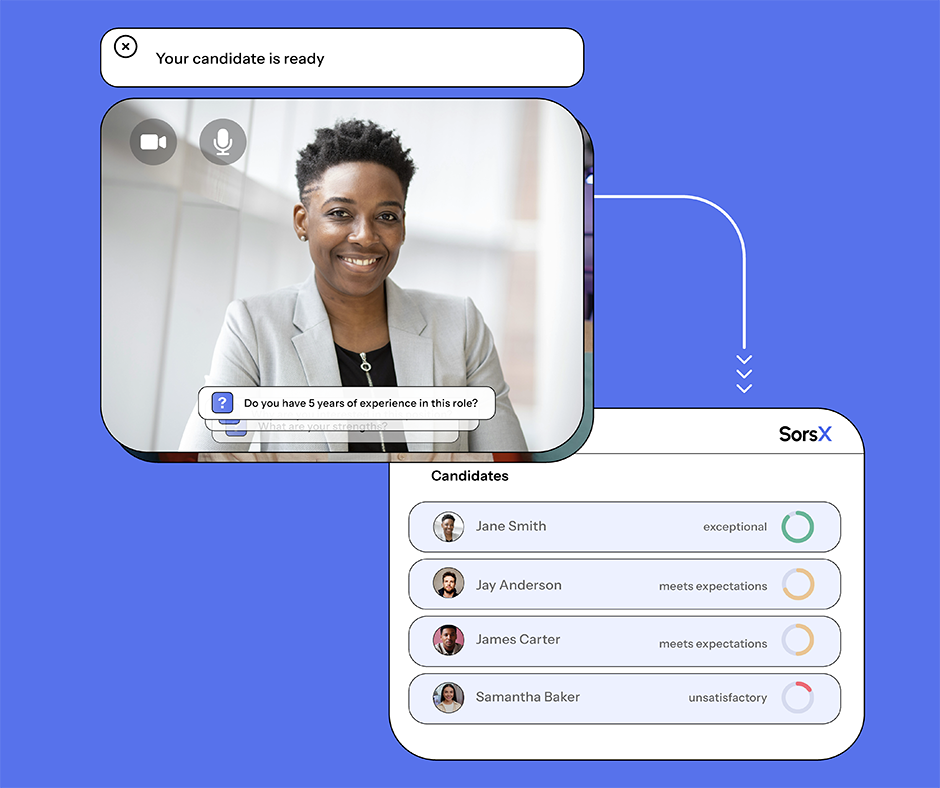
Platforms like SorsX allow every candidate to go through the same structured, asynchronous interview process. No more rushed calls or inconsistent question sets—just a fair, replicable experience that candidates can complete on their own time, from anywhere.
By scoring interviews based on the content of answers—not personality or presence—AI offers a more objective lens into potential. It’s a shift from “first impression” hiring to data-backed, performance-based selection.
Transparency and Trust in the Process
That said, fairness isn’t just about technology—it’s about trust. Candidates need to know how decisions are made.
That’s why leading platforms prioritize transparency: giving candidates clear expectations, sample questions, and a clear explanation of how AI is used. And crucially, final hiring decisions remain in the hands of people.
Trust grows when candidates feel like they’re seen, heard, and evaluated fairly—even when AI is part of the process.
When AI and HR Work Together
One logistics company that adopted SorsX saw impressive results: time-to-hire dropped by 47%, offer acceptance increased by 32%, and the top of the funnel became significantly more diverse thanks to structured evaluation and async access.
When AI supports HR—rather than replacing it—the results are not only faster, but also fairer and more scalable.
Building a Fairer Hiring Process Starts Small
Creating a more equitable system doesn’t require massive change overnight. Start with structured questions. Align your evaluation criteria. Use AI to handle high-volume screening so you can focus your human attention where it matters.
Most importantly, make sure every candidate understands what to expect. Fairness starts with clarity—and grows through consistency.
Conclusion: Fast, Fair, and Human—With AI
AI in hiring isn’t about replacing people—it’s about removing barriers.
When used intentionally, it brings speed, fairness, and accessibility to the hiring process. And with platforms like SorsX, HR teams don’t have to choose between efficiency and empathy.
AI interviews are becoming the new standard in hiring. Discover how artificial intelligence reduces time-to-hire, improves candidate experience, and gives growing teams a competitive edge in 2025.
The AI Recruiting Revolution in Modern Hiring
Most companies are still losing time and talent at the top of the funnel. While hiring technology has evolved dramatically, traditional interview scheduling remains the biggest bottleneck in modern recruitment. In fact, 35% of recruiters’ time is spent on interview scheduling, turning what should be a strategic relationship-building process into an administrative burden.
Here’s the reality: companies using AI interviews report a 50% reduction in time-to-hire, while the broader market struggles with inefficiency. This isn’t just about convenience—it’s about competitive advantage in the talent acquisition war powered by artificial intelligence.
This blog explores how AI recruiting is changing the game—and why it’s not just faster, but fundamentally better for both companies and candidates.
The Problem: Why Traditional Interview Processes No Longer Work
Beyond Traditional Methods: AI Interviews as Standard Practice
While remote work accelerated AI interviewing adoption, the sustained growth reveals deeper structural advantages in AI recruiting. Organizations increasingly seek AI interview platforms that combine intelligent screening, automated evaluation, and seamless integration capabilities. This evolution shows companies moving from reactive crisis management to proactive recruitment optimization.
For Hiring Teams: Operational Excellence in AI Recruiting
Elimination of Interview Scheduling Friction: The most immediate benefit is transformative. AI interviews completely eliminate the coordination nightmare that consumes 35% of recruiters’ time. No more calendar Tetris, no more missed calls, no more rescheduling cascades in your recruitment process.
For Candidates: Flexibility and Fairness in AI Hiring
Time and Location Flexibility: Candidates can complete AI interviews when they’re most prepared, not when calendars align. This especially benefits working professionals, parents, and students who struggle with traditional interview scheduling constraints.
Reduced Stress and Better Performance: AI interview systems typically allow candidates time to prepare thoughtful responses, leading to more authentic evaluations. The AI-powered interview format removes real-time pressure while maintaining assessment quality.
Mobile-First AI Interview Experience: 68% of candidates prefer mobile-friendly platforms, and AI interviews deliver true mobile optimization. Candidates can complete AI-powered assessments from anywhere with reliable internet, expanding access beyond traditional office environments.
Consistent Candidate Experience: Every candidate gets identical treatment through AI recruiting—same questions, same evaluation criteria, same scoring methodology. This consistency addresses growing fairness concerns in hiring processes.
Addressing the Trust Gap: Fairness and Transparency in AI Hiring
Best Practices for Trust Building in AI Recruiting
Transparency in AI Interview Process: Candidates should understand exactly how AI algorithms evaluate them. Clear instructions, sample questions, and evaluation criteria reduce anxiety and improve performance in AI-powered interviews.
Getting Started: AI Interview Implementation Best Practices
Design Structured, Inclusive Questions for AI Screening
Start with job-relevant competencies and create questions that assess specific skills through AI evaluation. Avoid open-ended questions that invite bias and focus on behavioral examples that predict performance in your AI-powered hiring process.
Share AI interview results across decision-makers to gather diverse perspectives. This approach leverages artificial intelligence efficiency while maintaining human judgment in final hiring decisions.
Measure and Optimize AI Recruiting Efficiency
Track key metrics like candidate completion rates, time-to-hire reduction, and quality of hire from AI interviews. Use data to continuously improve question design and AI evaluation processes in your talent acquisition strategy.
The Future: AI Interviews as Hiring Infrastructure
Beyond Trend to Standard Practice in AI Recruiting
This isn’t about replacing human connection—it’s about optimizing where human time creates the most value in AI-powered recruiting. Recruiters can focus on relationship-building, employer branding, and strategic candidate engagement rather than administrative coordination.
Universal Benefits for AI Hiring Teams
The advantages of AI interview software span every stakeholder:
Founders and hiring managers get faster, more consistent AI-powered hiring decisions
Recruiters reclaim time for high-value activities and strategic thinking
Candidates experience fairer, more convenient AI evaluation processes
Companies build stronger employer brands through improved AI candidate experience
The data is clear: AI interviews aren’t just a competitive advantage—they’re becoming table stakes in modern talent acquisition. Companies that embrace this AI hiring technology early gain significant advantages in speed, efficiency, and candidate experience.
The question isn’t whether AI recruiting will become standard, but whether your company will lead or follow the transformation in AI-powered hiring.
Try your first AI interview with SorsX today. No scheduling. No bias. Just better hiring. Start your free trial
Rapid artificial intelligence (AI) adoption across HR departments highlights a critical need for targeted, role-specific training to unlock its full potential. A recent survey by General Assembly reveals a stark contrast between AI adoption and adequate training: 82% of HR professionals now utilize AI recruiting tools, yet only 30% have received comprehensive, job-specific AI training. This significant training gap leaves many HR professionals navigating sophisticated technologies on their own, undermining confidence and effectiveness.
Organizations in hospitality, construction, non-profit, and technology industries are increasingly recognizing the benefits of AI recruitment automation. These benefits include streamlined resume evaluation, enhanced applicant tracking systems (ATS), and adaptive, automated interviewing processes. However, without tailored training, HR teams can miss key opportunities for optimization, resulting in decreased productivity gains and reduced strategic focus.
The survey underscores the value of targeted AI training: HR professionals who received specialized instruction were 35% more confident in their AI skills compared to those who learned independently. This confidence directly translates into greater efficiency and effectiveness in critical HR functions such as workforce planning, designing training materials, and drafting employee communications. At SorsX, we address this training gap by providing intuitive, user-focused AI recruiting solutions that seamlessly integrate into HR workflows. Our ScaleHire platform automates resume screening, candidate engagement via email and SMS, and dynamic, adaptive interviewing, significantly reducing the manual workload for HR teams. By coupling powerful AI recruitment technology with role-specific training resources, SorsX empowers HR professionals to leverage AI confidently and strategically.
HR teams trained specifically in AI applications report not only higher confidence but also greater productivity, more strategic engagement, and improved outcomes in talent acquisition. Companies looking to maintain a competitive edge and optimize their HR processes must prioritize role-specific AI training.
Explore how SorsX can transform your recruiting approach, enhance your team’s skills, and drive tangible hiring results through effective AI implementation. Experience the difference firsthand with a complimentary trial of our AI-powered recruiting solutions.
As hiring becomes more competitive and candidate expectations rise, companies across hospitality, construction, non-profit, and tech industries are looking to AI to automate recruitment and they’re not looking back. Keywords like AI recruiter, AI recruitment, AI recruiting, applicant tracking system, and resumes aren’t just buzzwords—they’re the foundation of smarter, faster, and fairer hiring.
Why Automation Matters in Modern Hiring
Efficiency & Time Savings According to Deloitte, over 56% of organizations use GenAI and agentic AI to drive hiring productivity and transformation (Recruiter Flow, Deloitte). SmartRecruiters reports 75% of recruiters say AI-powered ATS tools reduce time-to-hire by 30% or more (Recruiter Flow).
Improved Decision-Making AI systems go beyond keyword matching—they leverage predictive analytics and contextual screening to identify top candidates, promote inclusion, and reduce bias (ATSOndemand).
Enhanced Candidate Experience Automated outreach, real-time application updates, and personalized communication ensure candidates aren’t left in the dark—building employer trust and brand reputation (Radancy Blog).
Top 5 Trends in Recruitment Automation
Full-Funnel AI Recruiter Agents Platforms like SorsX fully automate sourcing, ranking, and re-engagement—covering over 90% of recruitment workflows and reducing cost-per-hire by 50% (Wikipedia).
ATS + AI Recruiting Integration Modern applicant tracking systems now include AI resume parsing, interview scheduling, analytics, and candidate engagement—all in one centralized portal (MSH, Wikipedia).
Dynamic, Adaptive Interviews AI-powered audio/video interviews adjust questions in real time based on candidate responses—enhancing both fairness and assessment quality (Sira Consulting).
Ethical & Fair AI As AI-generated resumes proliferate, human oversight remains critical to preserve authenticity. Companies like Anthropic now encourage transparent, candidate-driven use of AI tools (Oleeo, Business Insider).
AI-Driven Talent Analytics & Predictive Hiring From forecasting candidate performance to workforce planning, AI-driven insights are reshaping recruitment strategy and reducing churn (vanillahr.com).
Upgrade Your ATS with AI resume parsing, predictive analytics, and automated outreach capabilities.
Implement Adaptive AI Interviews to evaluate both technical and soft skills dynamically.
Balance Automation with Oversight—keep the human in the loop to ensure bias mitigation and authenticity.
Monitor & Optimize using data-driven insights—track metrics like time-to-hire, cost-per-hire, and candidate satisfaction.
Join the Next Generation of Recruiting
At SorsX, we’re at the forefront of this transformation. Our ScaleHire platform offers:
AI-powered resume screening & outreach
Adaptive audio/video interviewing
Candidate ranking with analytics
Hands-free automation with human oversight
Ready to accelerate your hiring, improve quality, and stay ahead of talent trends? Let’s start a conversation.
Final Takeaway
Recruitment automation isn’t a fleeting trend—it’s now mission-critical. By integrating AI recruiters, ATS enhancements, and adaptive interviews, companies can hire smarter, faster, and fairer. Those who embrace it today won’t just fill roles faster—they’ll redefine how the world hires.
1. Employee absenteeism When employees are frequently absent from work, which can impact productivity and morale.
2. Applicant Tracking System (ATS) A digital tool that helps HR teams manage job applications, track candidates, and streamline the hiring process.’
3. Attrition The natural reduction of staff through resignations, retirements or other reasons that are not firings.
4. Base Salary The fixed amount of money paid to an employee, not including bonuses, benefits or overtime.
5. Behavioral Interview A type of interview that asks candidates to describe past experiences to predict future performance.
6. Benefits Non-wage perks provided by employers, such as health insurance, retirement plans and paid time off.
7. Compensation The total pay and benefits package offered to an employee, including salary, bonuses and perks.
8. Contingent Worker An employee hired on a temporary, freelance, or contract basis rather than as a permanent staff member.
9. DEI (Diversity, Equity and Inclusion) Initiatives to ensure fair treatment, access, and opportunity for all employees, regardless of background.
10. Employee Life Cycle The stages an employee goes through at a company, from recruitment to exit and even alumni relations.
11. Employment Contract A legal document outlining the terms and conditions of employment between employer and employee.
12. Employment Status Defines whether an employee is full-time, part-time, temporary or freelance, affecting benefits and rights.
13. Gross Salary The total pay an employee earns before deductions like taxes and retirement contributions.
14. Job Description A written summary of the responsibilities, duties and qualifications for a specific job.
15. Job Dissatisfaction When employees feel unhappy or unfulfilled in their roles, often leading to turnover.
16. Learning & Development (L&D) Programs and activities designed to enhance employees’ skills and knowledge.
17. Minimum Wage The lowest hourly or monthly pay that employers are legally allowed to offer.
18. Net Salary The amount an employee takes home after all deductions, sometimes called “take-home pay.”
19. Offboarding The process of managing an employee’s exit from the company, including knowledge transfer and exit interviews.
20. Onboarding The process of integrating new hires into the organization, helping them get up to speed with their role and company culture.
21. Organizational Development Efforts to improve a company’s effectiveness through planned interventions and strategies.
22. Performance Management Ongoing processes to evaluate and improve employee performance, often using regular reviews and feedback.
23. Recruitment The process of finding, attracting, and hiring the best candidates for open positions.
24. Retention Strategies and practices aimed at keeping talented employees and reducing turnover.
25. Succession Planning Preparing employees to fill key roles in the future, ensuring business continuity.
26. Talent Acquisition A broader approach to finding and hiring top talent, often including employer branding and workforce planning.
27. Turnover Rate The percentage of employees who leave a company over a certain period, a key HR metric.
28. Sourcing Sourcing is the very first stage of the recruitment process, where HR professionals proactively search for potential candidates to fill current or future job openings. Instead of waiting for applicants to come to you, sourcing means actively looking for both active (currently job-seeking) and passive (not actively looking) candidates across platforms like LinkedIn, job boards, social media, industry events, and referrals. The goal is to build a pool of qualified talent—sometimes even before a job is posted—so your company is ready to move fast when a new position opens up.
29. Hiring Hiring is broader, multi-step process that starts once you have a pool of candidates (often from sourcing) and ends when a new employee joins your team. The hiring process includes everything from identifying the need for a new hire, creating a job description, posting the job, screening applicants, conducting interviews, assessing skills, checking references, making an offer and onboarding the new employee
30. AI Interviews Modern hiring managers and employers face persistent pain points in the interview process: manual screening, inconsistent evaluations and escalating costs. SorsX developed AI Interview that solves these challenges with an AI-powered process that works so you don’t have to. Receive clear candidate summaries with scores for accuracy, knowledge level and role fit. Whether screening 1 or 1,000 candidates, SorsX lets applicants interview on their own time. You focus on evaluating results, not on interview logistics or endless scheduling.
Why these terms matter in 2025
HR is no longer just about paperwork. It is about creating cultures where people thrive and businesses grow.
Knowing these terms helps you communicate clearly, stay compliant and make informed decisions as HR evolves with technology, remote work and new legal requirements.
Sourcing is about finding and engaging potential candidates (often before they even apply), focusing on building a talent pool for current and future needs.
Key steps in sourcing:
Understanding the job requirements and ideal candidate profile
Searching for candidates online and offline
Reaching out and engaging with potential candidates
Building and maintaining a talent database for future needs
Sourcing is strategic: it helps create a robust talent pipeline, shortens time-to-hire, and gives companies access to candidates who might not apply on their own.
Hiring is the entire process of bringing someone on board, from identifying the need to onboarding the new team member. It includes screening, interviewing, evaluating, and making the final offer.
Key steps in hiring:
Planning and defining the hiring need
Creating and advertising the job opening
Screening and shortlisting applicants
Interviewing and assessing candidates
Conducting background and reference checks
Making a job offer and negotiating terms
Onboarding the new hire
Hiring is about selecting and securing the best-fit candidate for your open role, ensuring they are a good match for both the job and your company culture.
Hiring is about selecting and securing the best-fit candidate for your open role, ensuring they’re a good match for both the job and your company culture
How SorsX makes sourcing and hiring effortless
SorsX streamlines both sourcing and hiring by combining live recruiter network-powered talent discovery with an AI Interview technology that handles interviewing part instead of a recruiter or hiring manager.
For sourcing: Live crowdsourced recruiter network that sources candidates for you. Using SorsX sourcing, you get candidates delivered, not searched. The best part is that you will post your role only once and other recruiters will source for you.
For hiring: SorsX automates screening, interview scheduling and analysis, so you can work on other tasks while candidates are answering interview questions. Good news is that SorsX AI will generate interview questions and ensure that technical assessments are consistent and accurate, no matter the role.
“We were facing many polished resumes, but unqualified applicants. Because of that, we were wasting hours every week on first-round interviews. When we started using SorsX and its AI Interview tool, within 48 hours we had already pre-screened candidates ranked by their AI interview performance. A game-changer!” — WadiTek
Hiring the right people is more challenging than ever. Whether you are a tech recruiter, hiring manager or founder, knowing which interview questions to ask is the most important part of your hiring process.
In 2025, with remote work, AI recruiting software and evolving job requirements, you need to ask the right questions, and more important – you need to understand and evaluate answers. This is not easy, especially when it comes to deep technical assessments.
To help you handle this complex part of hiring, this guide covers:
The most effective interview questions to ask candidates
Internal interview questions for current employees
Strategic interview questions for leadership and specialized roles
How AI tools can streamline your interview process
Most Popular Interview Questions to Ask Candidates
Modern interviews go beyond “Tell me about yourself”. Today’s best hiring platforms and AI recruiting solutions focus on digital fluency, adaptability and culture fit. Talent acquisition now centers on data-driven recruiting, scalable sourcing workflows, candidate experience optimization and processes that align with employer branding and long-term workforce planning. Here are some of the most frequently searched and effective questions for 2025:
How do you maintain productivity when working remotely? Shows self-discipline, time management, and tech-savvy—key for hybrid teams.
Describe a time you collaborated with team members in different locations or time zones. Assesses digital communication skills and adaptability.
What’s your greatest professional achievement? Reveals what candidates value and their impact.
Tell me about a time you failed. How did you handle it? Tests resilience and growth mindset.
What tools or software have you used in your previous roles? Important for tech recruiters and ai recruiters to gauge digital literacy.
Why do you want to work here? Checks motivation and employer research.
How do you keep up with industry trends or new technologies? Shows initiative and willingness to learn, especially for roles in fast-moving sectors.
What are your compensation expectations? Ensures alignment and transparency early on.
How would your coworkers describe you? Assesses self-awareness and culture fit.
Do you prefer working independently or on a team? Why? Helps match candidates to your company’s work style.
Internal Interview Questions: For Employees Seeking New Roles
Promoting from within is smart, but internal interviews need a different approach. Here are the best questions to assess internal mobility, growth, and leadership potential:
Motivation & Growth What made you interested in this new role? What have you learned in your current position that will help you succeed in this new role? Where do you see yourself in five years?
Adaptability & Learning Tell us about a challenge you faced in your current role and how you overcame it. Are you willing to undergo training to prepare for this new position?
Collaboration & Feedback How would your supervisor describe you? Give an example of a time you resolved a conflict with a coworker. What communication style do you prefer, and why?
Leadership Potential Describe your leadership style. Tell us about a project where you took the lead. How did you delegate tasks? How would you handle conflict within a team?
Hard Skills & Achievements What makes you a strong fit for this role? Tell us about a time you improved a process or contributed to company goals.
Crafting and evaluating these questions, especially for technical roles, takes time and expertise. Luckily, it’s 2025 and AI can be a major help.
“We were facing many polished resumes, but unqualified applicants. Because of that, we were wasting hours every week on first-round interviews. When we started using SorsX and its AI Interview tool, within 48 hours we had already pre-screened candidates ranked by their AI interview performance. A game-changer!” — WadiTek
Imagine if you could generate the perfect set of interview questions for any role: technical or strategic, in seconds.
Instant question generation Enter your role requirements and SorsX creates tailored interview questions. Perfect for any roles, especially technical ones, SorsX AI Interview is consistent and accurate.
Seamless candidate experience Invite candidates to complete interviews on their schedule. This means no more calendar headaches or no-shows. And you don’t even have to be there – interview starts when they click start, answers are automatically analyzed in real time and each answer is scored for overall knowledge, accuracy and comprehensiveness.
Clear, actionable results Get instant scoring and summaries for every candidate. This not only provides clear, actionable interview results instantly, but also reduces bias and increases fairness in hiring, making hiring decisions faster and easier.